Some Equations Relating to Radioactivity
There are 5 variables to be considered here:
- h: half-life
- m: mean lifetime
- k: decay constant
- A: activity (number of decays per unit time)
- N: number of particles
The normal metric unit for activity (A) is the becquerel (Bq) which in base units is  ; however the non-metric unit for activity is still often used: the curie (Ci) which is
 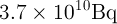 .
.
The first three variables are independent of the number of particles or the activity; they are different ways of referring to the same property of a particular type of nuclide. The last two depend on the number of particles in question as well.
While the half-life (h) is usually given, the equations relating activity (A) to number of particles (N) is more simply expressed with the decay constant (k); so one needs to be able to convert the half-life to a decay constant:  .
.
Then, the activity (A) of an object with N particles is simply  . This equation, when rearranged, also allows one to calculate the number of particles from the activity:
  .
.
Finally, another rearrangement of this equation gives a notion of what one definition of the decay constant (k) is:  ; the decay constant can be defined as the decays per unit time per number of particles.