(Trigonometric) Identities Can Be Proved by Manipulating Both Sides!
I first read it on the Internet: that one could not prove trig identities by manipulating both sides of the purported identity at the same time. I checked the textbooks that I have easy access to and found the same claim in 5 out of the 7 textbooks that I have checked. However, in my high school classes we were allowed to and shown examples that manipulate both sides at the same time. For example, those making this claim would consider the following proof of  to be invalid.
1:
2: 
3: 
4: 
5: 
6: 
7: 
Since I have just shown that the original to be equivalent to the accepted trig identity of , then I should be able to claim that I have proved the original statement to be true. The step from equation 3 to equation 4 divides both sides by  ; this step could not be done to both sides separately. Since this step, in particular, would be objected to by many teachers, I intend to show that one can, in fact, do steps like this in proving identities.
The proof involves reversibility. Assume that one starts with an equation and turns it in to an accepted identity, such as , then one can reverse the steps by starting with the accepted identity and applying the inverse operations in the reverse order. For example, assume that a, b, c, d, and x are (possible complicated expressions. If it is permissible to transform a=b to a+x=b+x to c=d, then it is also permissible to transform c=d to c-x=d-x to a=b. Likewise subtraction can be reversed by addition, multiplication by division, and division by multiplication. One might object that that for multiplication and division that the process might not work because of the possibility that x could evaluate to 0, but note that multiplication is forbidden if and only if division is forbidden; though I'll come back to that point.
If one starts with the accepted identity and goes in reverse to get the desired identity to be proved then the objection that one can not assume what is not known no longer applies; and I have shown that if one can use the manipulations of addition, subtraction, multiplication, and division to get from the questioned identity to an accepted identity one must also be able to get from the accepted identity to the questioned identity. For example my proof of above can be straightforwardly transformed in to the following:
1:
2:
3:
4:
5:
6:
7:
As, indeed any proof of my type can be transformed.
Now what about the objection that while can not be 0, that other expressions one might use might be equal to 0 at some point: even sin θ is zero every once every half-cycle. However, the standard transform one side in to the other does not protect against errors involving 0 either. Take the following "identity" to be "proven" that appeared as the second student problem on the exact same page as the following text:
You cannot [emphasis in original] establish an identity by such methods as adding the same expression to each side and obtaining a true statement. The practice is not allowed because the original equation is precisely the one you're trying to establish. You don't know until it has been established that, in fact, it is true.
Establish csc θ · tan θ = sec θ.
One is supposed to "prove" it like this:
1: 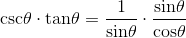
2: 
3: 
4: 
5: 
6: 
So we've just "proved" csc θ · tan θ = sec θ, except that we haven't because I can give a counterexample. Take θ to be 180° (or π radians, if you like): then, sec θ = sec 180° = -1, and tan θ = tan 180° = 0, but csc θ = csc 180° which is undefined, and thus csc θ · tan θ is undefined and thus not equal to sec θ at θ=180°.
Now perhaps the problem is obvious by now, but that is almost certainly because we have been discussing zero and I have given the steps in the "proof" to a level of detail that no student at this level would still be using. The problem is in step 4, where we assumed that  . When sin θ is 0, then the expression
  is also undefined. This is also consistent with my counterexample, sin 180° = 0. Indeed, csc θ · tan θ = sec θ fails everywhere sin θ = 0.
One minor objection is to writing an equals sign when the original equation is not known to be true until the final step; ie, writing and then , etc when those are not yet known to be true. One solution is to use the symbol that I have seen used seen used in other contexts; placing a question mark over the equals sign, ≟, that is writing  at the start instead, and then retaining the question mark over the equals sign until the final equation.
The other possibility is writing "iff" (standing for "if and only if" between the equations which would when upon reaching the final true (or false) equation would allow one to project back the truth values because of the "only if" part of the statements. This would also leave room to include a "provided that ..." statement; that is for example "provided that 1 - sin θ ≠ 0". This "provided that ..." statements would make it easier to check if one does have locations where the "identity" is not true.